Identifying Common Bee Diseases: A Visual Guide
In short
Learn to recognize the telltale signs of the most common honey bee diseases—from American Foulbrood to Nosema—and understand when to act.
By Willi Van Boven — Beekeeper and founder of ApiaryPilot. About the author
Published · Last updated
Early detection of bee diseases can mean the difference between saving a colony and losing it—along with neighboring hives. Every beekeeper should be able to recognize the visual signs of the most common diseases. This guide walks you through what to look for, what it means, and what to do about it.
The Importance of Regular Health Checks
Disease doesn't announce itself with a banner. It creeps in gradually, and by the time symptoms are obvious, the colony may already be seriously compromised. That's why health assessment should be part of every inspection—not a separate, occasional activity.
Train your eye to notice subtle changes: shifts in brood pattern, unusual smells, changes in bee behavior at the entrance, and differences in cappings texture.

American Foulbrood (AFB)
Severity: Critical — Notifiable disease in most countries
American Foulbrood is caused by the spore-forming bacterium Paenibacillus larvae. It's the most serious brood disease and is highly contagious. Spores can remain viable for over 50 years in contaminated equipment.
What to Look For

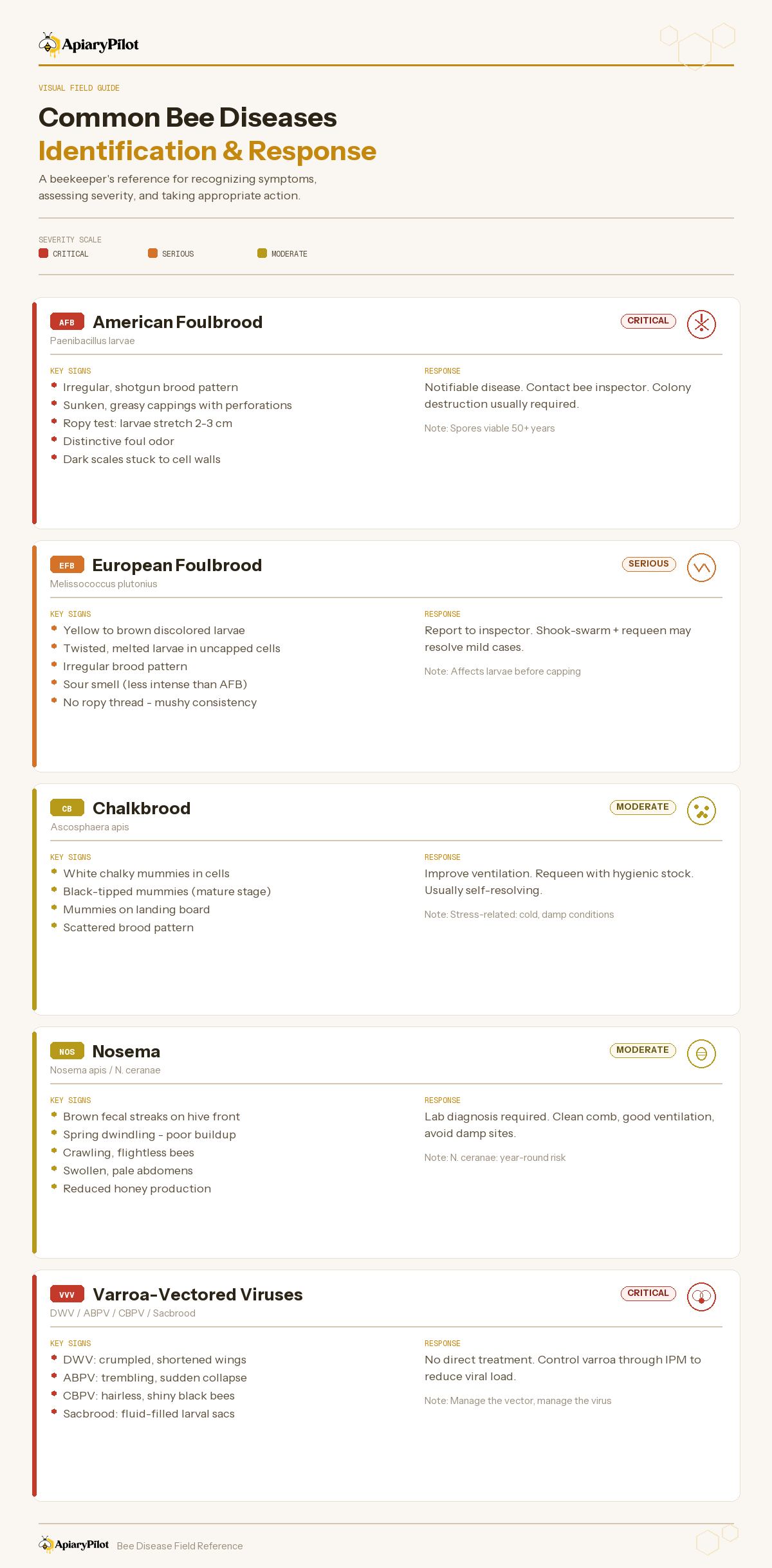
- Irregular brood pattern – Healthy capped brood is solid and uniform. AFB creates a "shotgun" pattern with scattered empty cells among capped ones
- Sunken, greasy-looking cappings – Healthy cappings are slightly convex and dry; AFB cappings become concave and appear wet or oily
- Perforated cappings – Small holes in cell caps where bees have partially uncapped and failed to remove diseased larvae
- Ropy test – Insert a matchstick into a suspect cell and slowly withdraw it. AFB-infected larvae will stretch into a ropy, mucus-like thread 2-3 cm long. This is the definitive field test
- Foul smell – Advanced cases produce a distinctive, unpleasant odor (hence the name)
- Dried scales – Dead larvae dry into dark brown or black scales that are firmly attached to the lower cell wall and almost impossible to remove
What to Do
In most countries, AFB is a legally notifiable disease. Contact your local bee inspector immediately. Affected colonies typically must be destroyed (burned), and all equipment sterilized or destroyed. Never attempt to treat AFB with antibiotics without legal authorization.
European Foulbrood (EFB)
Severity: Serious — Notifiable in many regions
Caused by Melissococcus plutonius, EFB is less devastating than AFB but still serious. Unlike AFB, it affects larvae before capping, and colonies can sometimes recover.
What to Look For
- Discolored larvae – Healthy larvae are pearly white and curled in a C-shape. EFB-infected larvae turn yellow, then brown
- Twisted larvae – Instead of the normal C-position, infected larvae may appear stretched, twisted, or melted in their cells
- Irregular brood pattern – Similar to AFB but typically in uncapped cells
- Sour smell – Less intense than AFB but still noticeable
- No ropy test – Unlike AFB, EFB larvae don't form ropy threads; they're more mushy and granular
What to Do
Report suspected cases to your bee inspector. Mild cases may be treated by requeening and shook-swarming (transferring bees to new frames and foundation). Severe cases may require colony destruction.
Chalkbrood
Severity: Moderate — Usually self-limiting
Caused by the fungus Ascosphaera apis, chalkbrood is common in spring when colonies experience temperature stress.
What to Look For
- Mummified larvae – Dead larvae become chalky white, hard mummies that resemble pieces of chalk
- Black-tipped mummies – As the fungus matures, mummies develop dark spots or turn completely black
- Mummies at the entrance – Hygienic bees will carry mummies out of the hive; you'll find them on the landing board and ground
- Scattered brood pattern – Empty cells where mummies have been removed
What to Do
Chalkbrood is usually a sign of stress—cold, damp conditions, poor ventilation, or a weak queen. Improve ventilation, ensure adequate insulation, and consider requeening with hygienic stock. Most colonies recover on their own as weather improves.
Nosema
Severity: Moderate to Serious

Nosema is a microsporidian gut parasite. Nosema apis causes classic spring dwindling, while Nosema ceranae (more recently spread from Asian honey bees) can cause year-round losses.
What to Look For
- Dysentery – Brown fecal streaks on the front of the hive and frames (more common with N. apis)
- Spring dwindling – Colonies that fail to build up as expected in spring
- Crawling bees – Workers crawling on the ground unable to fly
- Swollen, white abdomens – Infected bees may have distended, pale abdomens
- Poor honey production – Infected colonies are simply less productive
What to Do
Diagnosis requires microscopic examination of bee guts. Send samples to your local bee health lab. Good management practices help: ensure adequate ventilation, avoid damp sites, provide clean water, and replace old comb regularly.
Varroa-Associated Viruses
While varroa itself is a parasite (not a disease), the viruses it transmits are among the biggest killers:
| Virus | Key Signs |
|---|---|
| Deformed Wing Virus (DWV) | Crumpled, shortened wings on newly emerged bees |
| Acute Bee Paralysis Virus (ABPV) | Trembling, hairless, dark bees; sudden colony collapse |
| Chronic Bee Paralysis Virus (CBPV) | "Black robbers" — hairless, shiny black bees shunned by guards |
| Sacbrood Virus | Larvae fail to pupate; become fluid-filled sacs |
What to Do
There are no direct treatments for bee viruses. Control the vector: keep varroa populations low through IPM, and the virus load drops with it.
Building a Disease Detection Habit
The best disease management is prevention and early detection. Make health checks a routine:
- Every inspection – Glance at brood pattern, check for unusual smells or appearance
- Monthly – Do a more thorough brood assessment, looking at 3-4 frames in detail
- Quarterly – Perform varroa counts and consider sending samples for lab analysis
- Annually – Request a bee inspector visit if available in your region
Recording Health Data with ApiaryPilot
Tracking disease observations over time reveals patterns you'd miss otherwise. With ApiaryPilot, log symptoms, treatments, and outcomes for every hive. Set health alerts for mite thresholds, photograph suspicious brood for reference, and share observations with your local bee inspector directly from the app.
Ready to elevate your beekeeping?
Start tracking your hives, inspections, and harvests with ApiaryPilot — the modern hive management platform built for beekeepers like you.
Get started free