The Honey Production Cycle: From Nectar to Jar
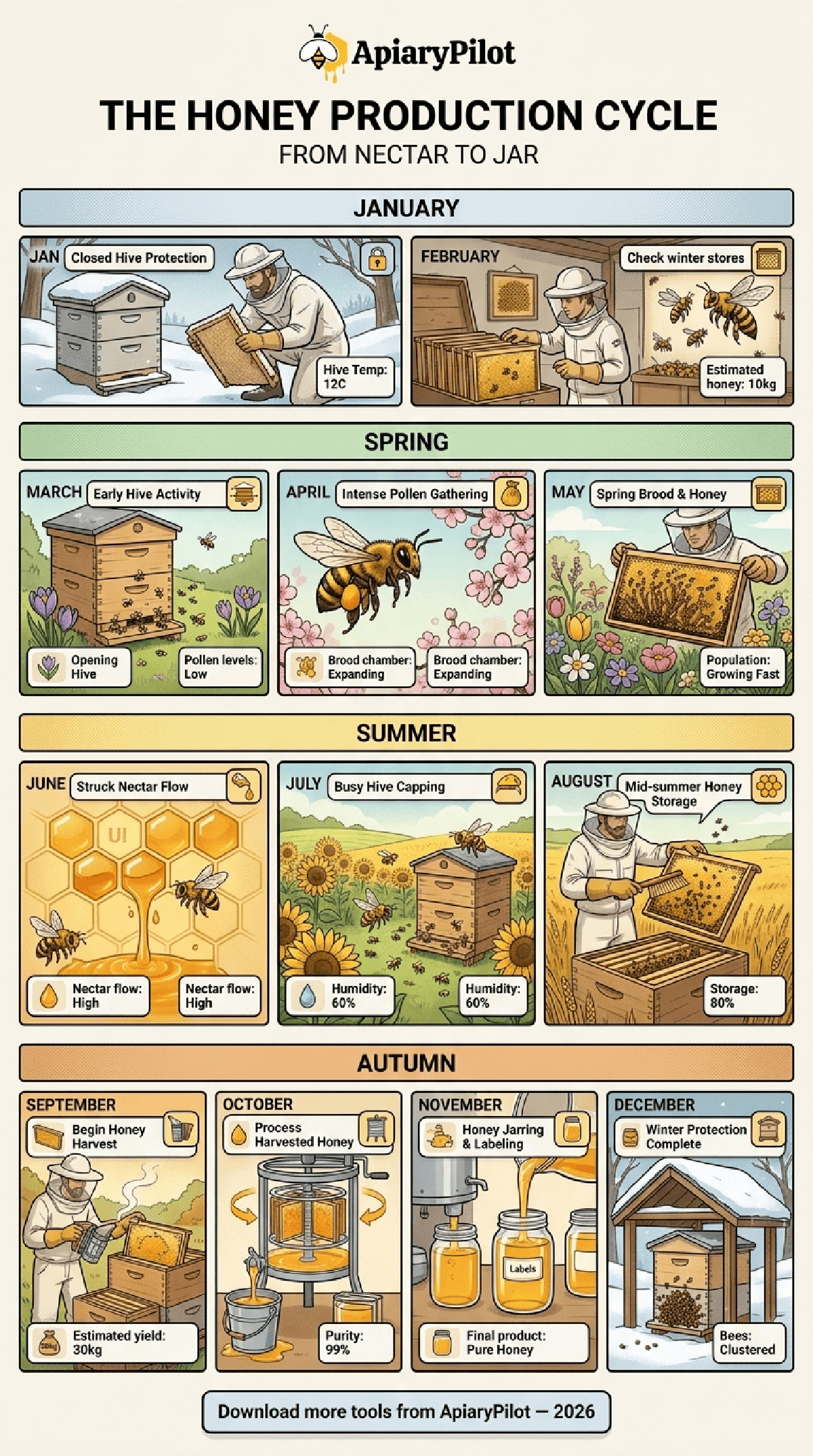
A month-by-month visual walkthrough of the honey production year — from winter cluster checks and spring brood build-up through the summer nectar flow to autumn extraction and jarring. See what your bees (and you) should be doing every month.
About this the honey production cycle: from nectar to jar infographic
This beekeeping infographic turns the key decisions behind the honey production cycle: from nectar to jar into a visual reference that can be used during inspections, planning sessions, or training conversations. It is designed for practical apiary management, so each section highlights the observations, timing, and records that matter most in the field.
Use it as a quick reminder before opening colonies, preparing seasonal work, or reviewing hive notes with another beekeeper. For stronger records, keep the infographic beside your inspection journal and capture the matching hive data in ApiaryPilot, including dates, colony status, treatments, harvest actions, and follow-up tasks.
The download below is suitable for printing or sharing with a local beekeeping group. The embed code lets clubs, educators, and suppliers reference the infographic while linking back to the original ApiaryPilot guide page.
Honey does not appear at extraction time — it is the result of twelve months of coordinated work between the colony, the landscape, and the beekeeper. This infographic maps the full annual cycle across four seasons and twelve months, so you can see at a glance where you are in the year and what should be happening next.
Winter: Protection and Stock-Taking
January — Closed Hive Protection
The colony is clustered and broodless (or nearly so). Your job is to stay out and let them be. A quick external check confirms the roof is on, the entrance is clear of dead bees and snow, and the hive is stable in the wind. Internal hive temperature at the cluster surface hovers around 12 °C, while the core stays close to 35 °C.
February — Check Winter Stores
Late winter is the most dangerous month for colony starvation. Heft each hive from the back to estimate remaining stores — a healthy colony at this point should still have around 10 kg of honey in reserve. If a hive feels light, add fondant directly above the cluster; do not open the brood nest.
Spring: Wake-Up and Build-Up
March — Early Hive Activity
First cleansing flights, first pollen coming in, first brood expanding. Pollen levels in the landscape are still low, so the queen is laying cautiously. Your first proper inspection of the year happens on a warm, still afternoon — check for the queen (or eggs), disease signs, and remaining stores.
April — Intense Pollen Gathering
The brood chamber is expanding rapidly. Foragers are hauling in loads of early pollen from willow, fruit blossom, and dandelion. Population is doubling roughly every three weeks. This is the month to reverse boxes if you overwinter in doubles, and to start planning your first supers.
May — Spring Brood & Honey
Colony population is growing fast and the first real honey flow begins in most regions. Add supers before you think you need them — bees that run out of space swarm. Watch for queen cells during every inspection.
Summer: The Nectar Flow
June — Peak Nectar Flow
The main flow is on. Nectar flow is high, foragers are working from first light to dusk, and the colony is at or near maximum population. Add supers early and keep the queen laying — a strong colony can fill a super in under a week during a good flow.
July — Busy Hive Capping
Bees have moved from collecting nectar to processing and capping it. Ambient humidity around 60 % slows the drying process; on humid weeks capping visibly lags. This is when a refractometer earns its keep — do not harvest anything that is not at least 80 % capped.
August — Mid-Summer Honey Storage
Storage in the supers is around 80 % full in a good year. Late-summer flows (heather, ivy, some clovers) may still add more. This is also the month to start planning your Varroa treatment window — brood levels are dropping and treatment efficacy climbs sharply.
Autumn: Harvest and Prepare
September — Begin Honey Harvest
Pull capped supers on a dry, sunny day. Expected yield for a healthy colony in a temperate climate is around 30 kg per hive, though this varies dramatically by region and forage. Leave enough stores on the hive for winter — take the surplus, not the pantry.
October — Process Harvested Honey
Uncap, extract, filter, and settle. Target moisture below 18 % and target purity above 99 % by removing wax fragments and air bubbles during settling. Bottle straight from the settling tank once the foam has risen.
November — Honey Jarring & Labelling
Jar, label, and record every batch. Traceability starts here: each label should tie back to the apiary, the hive, and the extraction date. This is also the month to complete your final Varroa monitoring and confirm winter stores are sealed and centred over the cluster.
December — Winter Protection Complete
Hives are wrapped or shielded, entrances are reduced, mouse guards are on, and the bees are clustered. Your role for the next two months is mostly to leave them alone — and to spend the quiet evenings cleaning equipment, rendering wax, and planning next year.
Track the Full Cycle with ApiaryPilot
Every stage in this cycle generates data worth keeping: inspection notes in spring, super additions in early summer, capping percentages in mid-summer, extraction weights and moisture readings in autumn, and treatment records year-round. ApiaryPilot's apiary management software ties them all to the same hive so that next year's decisions are informed by this year's numbers.
Ready to elevate your beekeeping?
Start tracking your hives, inspections, and harvests with ApiaryPilot — the modern hive management platform built for beekeepers like you.
Get started free