Infographic · · 5 min read
Sustainable Honey Production: Balance Nature and Yield
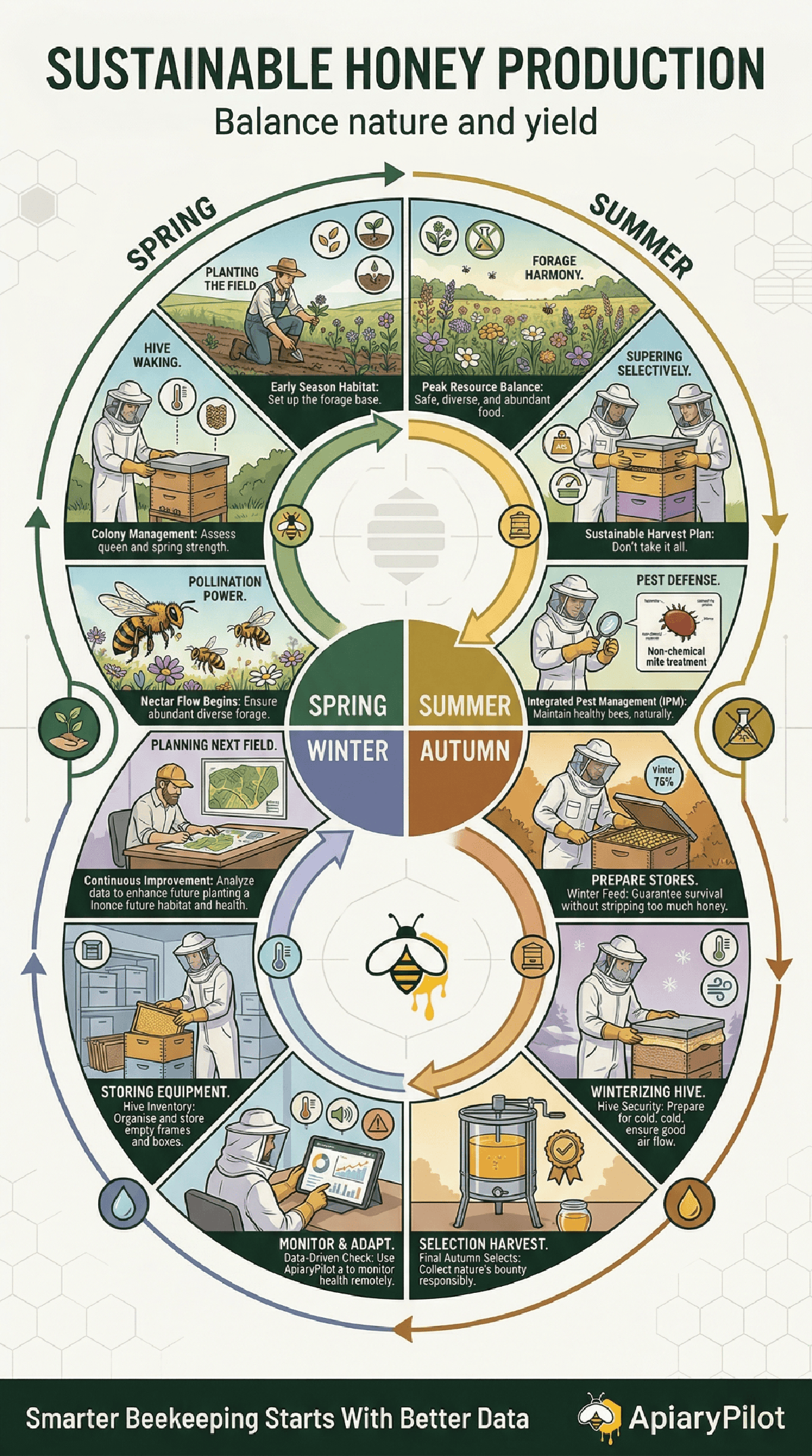
A year-round visual guide to sustainable beekeeping — pair pollinator-friendly forage, integrated pest management, and responsible harvesting across all four seasons.
Sustainable honey production is not a single technique — it's a year-round rhythm. The most resilient apiaries balance the colony's needs against the beekeeper's harvest, supported by diverse forage and gentle pest management. This infographic maps that rhythm across the four seasons.
Spring: Build the Foundation
Spring is the season of preparation. Pollinator-friendly forage planted now will feed the colony — and the wider ecosystem — for the rest of the year.
Core actions: - Plant the field: seed wildflowers, herbs, and early-blooming trees to establish the forage base - Hive waking: carry out the first spring inspection, assess queen status and cluster strength - Colony management: equalise weaker colonies with frames of brood from stronger ones - Pollination power: position hives to support local crops as the nectar flow begins
The goal is a colony that enters summer with a strong, healthy population and abundant, diverse forage within flight range.
Summer: Peak Resource Balance
Summer is when the apiary works hardest — and when sustainable choices matter most.
Core actions: - Forage harmony: maintain diverse forage; avoid relying on a single crop - Supering selectively: add supers only where colonies can fill them, keeping comb fresh - Sustainable harvest plan: don't take it all — leave reserves so the colony never approaches starvation - Pest defence (IPM): use non-chemical mite treatments where possible, prioritising drone-brood removal, screened bottoms, and monitored thresholds
Integrated Pest Management keeps mite pressure under control without compromising the colony or the honey.
Autumn: Prepare and Harvest Responsibly
As the flow tapers, the calculation shifts from production to survival.
Core actions: - Prepare stores: ensure each colony has enough winter feed before harvesting any surplus - Winterising the hive: insulate, ensure good airflow, and reduce the entrance against robbers and rodents - Selection harvest: collect only the genuine surplus, leaving generous reserves - Monitor & adapt: use ApiaryPilot to track weight and activity remotely as visits become less frequent
A colony that enters winter heavy, dry, and pest-free is a colony that produces sustainably for years.
Winter: Plan the Next Field
Winter looks quiet from the outside, but it's the season where next year's success is designed.
Core actions: - Planning the next field: analyse forage maps and plan plantings to enhance habitat and bee health - Storing equipment: organise and store empty frames and boxes, repairing what needs it - Continuous improvement: review last season's data — mite counts, harvest weights, queen performance — and adjust your plan - Hive security: keep the cluster undisturbed, monitor weight without opening the hive
Smarter Beekeeping Starts with Better Data
Sustainability is ultimately a data discipline. Every decision — when to add a super, how much honey to leave, whether to treat for mites, which colony to breed from — gets better when you can compare it against last year's outcomes. ApiaryPilot lets you log forage notes, harvest weights, IPM treatments, and seasonal observations in one place, so each year's apiary is a little wiser than the last.
Using this infographic
Keep it beside your inspection journal, print it for your club, or pin it in the honey room. Record the matching observations, treatments and follow-up tasks for each hive in ApiaryPilot.


