Infographic · · 4 min read
The Queen Excluder Explained: How It Controls Hive Movement
A visual guide to one of beekeeping's most debated tools — see how the queen excluder shapes brood, honey, and seasonal management across spring, summer, autumn, and winter.
The queen excluder is a deceptively simple piece of equipment — a flat grid with gaps just large enough for worker bees to pass through, but too narrow for the larger queen. Used well, it keeps brood and honey neatly separated. Used poorly, it can become a "honey excluder" that frustrates the colony. This infographic walks through how the excluder works in each season.
Spring Zone: Setting the Foundation
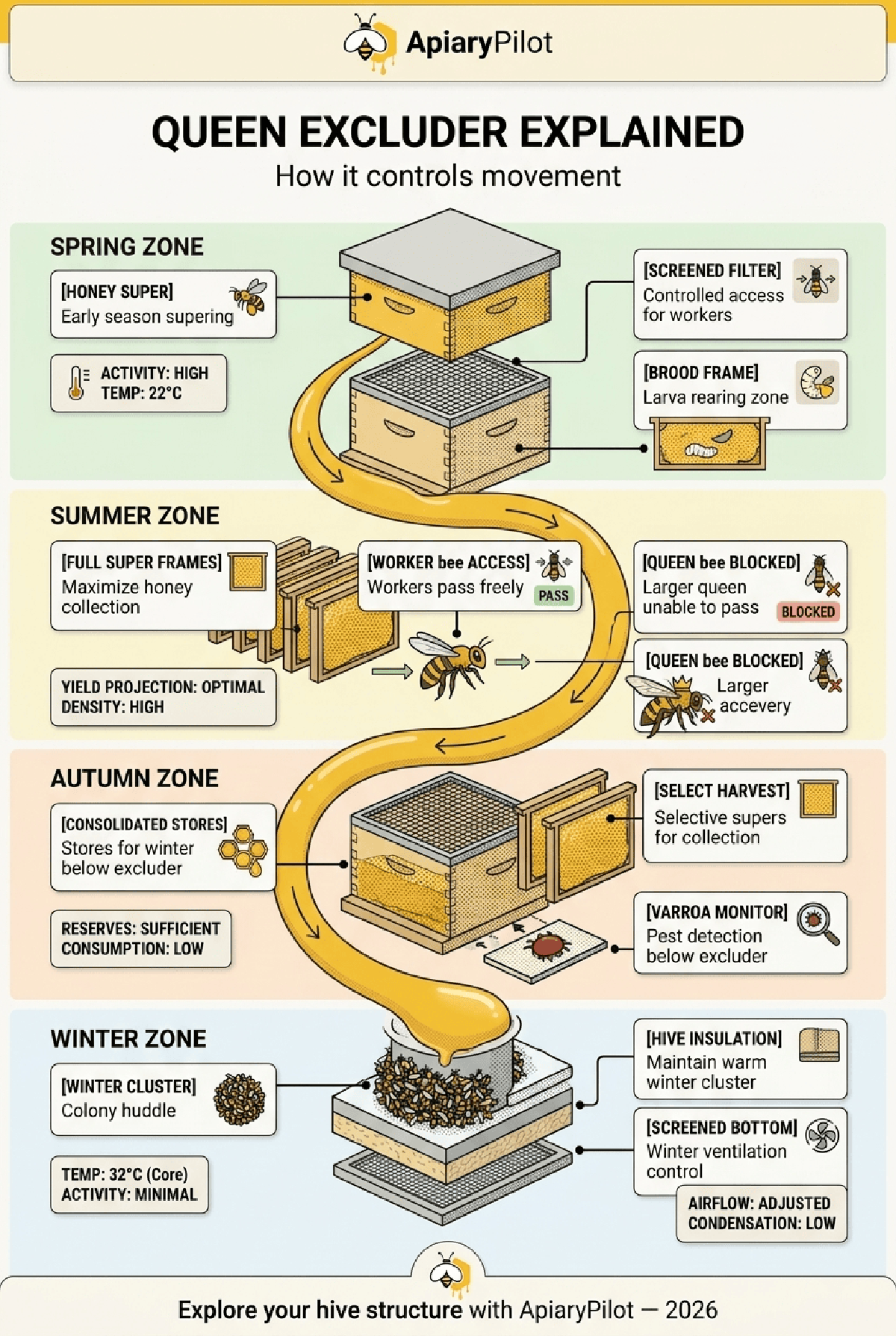
In early spring, the queen excluder defines the boundary between the brood nest below and the first honey super above. As temperatures climb toward 22°C and colony activity ramps up, workers move freely through the screened filter to fill the super, while the queen stays focused on laying in the brood frames below.
Key points: - Honey super placed above the excluder for early-season collection - Workers pass freely through the screened gaps - Queen confined to the brood box, focused on building population

Summer Zone: Maximising the Harvest
By summer, the excluder is doing its hardest work. Forager populations peak, and full super frames stack above the brood nest. Workers stream up and down through the grid all day, while the queen — physically too large to squeeze through — keeps the honey supers brood-free and harvest-ready.
Key points: - Full super frames maximise honey collection - Workers pass freely; queen is blocked by the narrow gaps - Optimal yield projection when colony density is high
Autumn Zone: Consolidating for Winter
As the season winds down, the excluder shifts roles. Beekeepers selectively harvest supers above the excluder while consolidating winter stores into frames below it, where the cluster will form. This is also a useful moment to monitor for varroa using a sticky board beneath the screened bottom — pest pressure tends to peak after the brood cycle slows.
Key points: - Selective harvest of supers above the excluder - Winter stores consolidated in the brood box below - Varroa monitoring beneath the excluder catches late-season mite drops
Winter Zone: Removing the Barrier
In most climates, the excluder should be removed before winter. A clustered colony moves vertically as it consumes stores, and a queen excluder above the cluster can trap the queen below while the rest of the colony moves up — leaving her to die of cold and starvation. Insulation, a screened bottom for ventilation, and an unobstructed cluster path are what matter now.
Key points: - Excluder removed so the queen can move with the cluster - Hive insulation maintains a warm 32°C cluster core - Screened bottom keeps ventilation steady, condensation low
When to Use It (and When Not To)
A queen excluder is most useful when you want clean, brood-free honey supers and disciplined seasonal management. It's less useful — and sometimes counterproductive — during a strong nectar flow when bees are reluctant to cross it, in very small colonies that haven't yet committed to working supers, or going into winter when the cluster needs vertical freedom.
Track Excluder Decisions in ApiaryPilot
Whether you run excluders all season or only at specific moments, recording when you add and remove them — alongside super counts, harvest weights, and varroa readings — makes patterns obvious across years. ApiaryPilot lets you log these events at the hive level so you can see which colonies thrive with an excluder and which prefer free vertical movement.
Using this infographic
Keep it beside your inspection journal, print it for your club, or pin it in the honey room. Record the matching observations, treatments and follow-up tasks for each hive in ApiaryPilot.


