Honeycomb Construction: How Bees Build Nature's Perfect Structure
Follow the five-step process of honeycomb construction — from wax secretion to the completed comb — and discover why the hexagon is nature's most efficient building shape.
About this honeycomb construction: how bees build nature's perfect structure infographic
This beekeeping infographic turns the key decisions behind honeycomb construction: how bees build nature's perfect structure into a visual reference that can be used during inspections, planning sessions, or training conversations. It is designed for practical apiary management, so each section highlights the observations, timing, and records that matter most in the field.
Use it as a quick reminder before opening colonies, preparing seasonal work, or reviewing hive notes with another beekeeper. For stronger records, keep the infographic beside your inspection journal and capture the matching hive data in ApiaryPilot, including dates, colony status, treatments, harvest actions, and follow-up tasks.
The download below is suitable for printing or sharing with a local beekeeping group. The embed code lets clubs, educators, and suppliers reference the infographic while linking back to the original ApiaryPilot guide page.
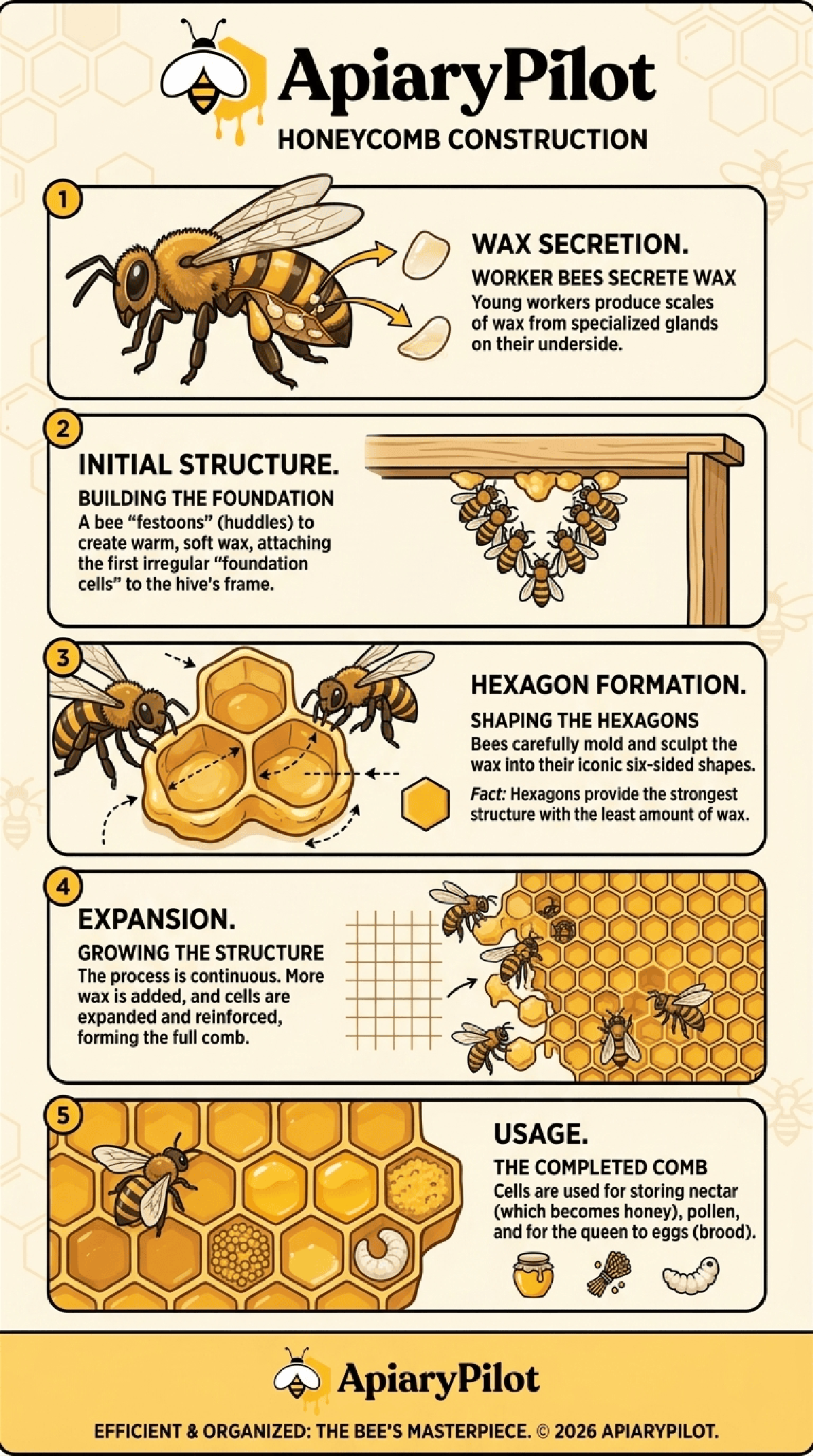
Honeycomb is one of nature's most remarkable engineering achievements. Built entirely from beeswax secreted by worker bees, the hexagonal structure is both incredibly strong and astonishingly efficient. This infographic walks through the five key stages of comb construction.
Step 1: Wax Secretion
The process begins with young worker bees (typically 12–18 days old) who have developed specialized wax glands on the underside of their abdomen. These glands produce tiny, translucent scales of beeswax — each about the size of a pinhead.
- A single wax scale weighs approximately 1.1 mg
- Bees must consume roughly 6–7 kg of honey to produce just 1 kg of wax
- The wax emerges as a liquid and hardens upon contact with air
Workers chew and manipulate these wax scales with their mandibles, mixing them with enzymes to create a pliable building material.
Step 2: Initial Structure — Building the Foundation
Construction begins at the top of the frame or cavity. Bees form "festoons" — chains of linked bees hanging from the top — creating a living scaffold. They attach the first irregular "foundation cells" to the surface, establishing an anchor point for the comb.
These initial cells are often irregular and serve primarily as attachment points. The precision comes in the next stage.
Step 3: Hexagon Formation — Shaping the Cells
This is where the magic happens. Bees carefully mold and sculpt the warm wax into their iconic six-sided hexagonal shapes. But why hexagons?
- Maximum space efficiency – Hexagons tile perfectly with no gaps, using the least amount of material to create the most storage space
- Structural strength – The hexagonal geometry distributes stress evenly across the comb
- The "Honeycomb Conjecture" – Mathematically proven in 1999 by Thomas Hales, hexagons are the most efficient way to partition a surface into equal areas with the least total perimeter
Each cell is angled slightly upward (about 13°) to prevent honey from flowing out before it's capped.
Step 4: Expansion — Growing the Structure
Comb building is a continuous, collaborative process. Thousands of bees work simultaneously, adding more wax, extending cells, and reinforcing walls. The comb grows downward and outward from the initial attachment point.
Workers constantly measure and adjust cell dimensions using their antennae and body parts as precision tools. The result is remarkably uniform — cells vary by less than 2% in diameter.
Step 5: Usage — The Completed Comb
The finished comb serves multiple critical functions:
- Honey storage – Nectar is deposited, ripened into honey, and sealed with wax caps
- Pollen storage – Packed pollen (bee bread) provides protein for the colony
- Brood rearing – The queen lays eggs in cells, and larvae develop within them
- Communication – Vibrations travel through the comb, enabling colony-wide communication
Appreciating the Craft with ApiaryPilot
Understanding comb construction helps you make better management decisions — from when to add foundation versus letting bees draw their own comb, to recognizing signs of healthy building activity during inspections. Log your observations about comb quality and building speed in ApiaryPilot to track colony vitality over time.
Ready to elevate your beekeeping?
Start tracking your hives, inspections, and harvests with ApiaryPilot — the modern hive management platform built for beekeepers like you.
Get started free