The Life of a Queen Bee: From Egg to Leader
Follow the complete lifecycle of a queen bee — from the moment an egg is laid in a royal cup through mating flights to her role as the heart of the colony.
About this the life of a queen bee: from egg to leader infographic
This beekeeping infographic turns the key decisions behind the life of a queen bee: from egg to leader into a visual reference that can be used during inspections, planning sessions, or training conversations. It is designed for practical apiary management, so each section highlights the observations, timing, and records that matter most in the field.
Use it as a quick reminder before opening colonies, preparing seasonal work, or reviewing hive notes with another beekeeper. For stronger records, keep the infographic beside your inspection journal and capture the matching hive data in ApiaryPilot, including dates, colony status, treatments, harvest actions, and follow-up tasks.
The download below is suitable for printing or sharing with a local beekeeping group. The embed code lets clubs, educators, and suppliers reference the infographic while linking back to the original ApiaryPilot guide page.
The queen bee is the most vital member of any colony — yet her journey from a tiny fertilized egg to the ruling matriarch is one of nature's most remarkable transformations. This infographic walks you through every stage of her life.
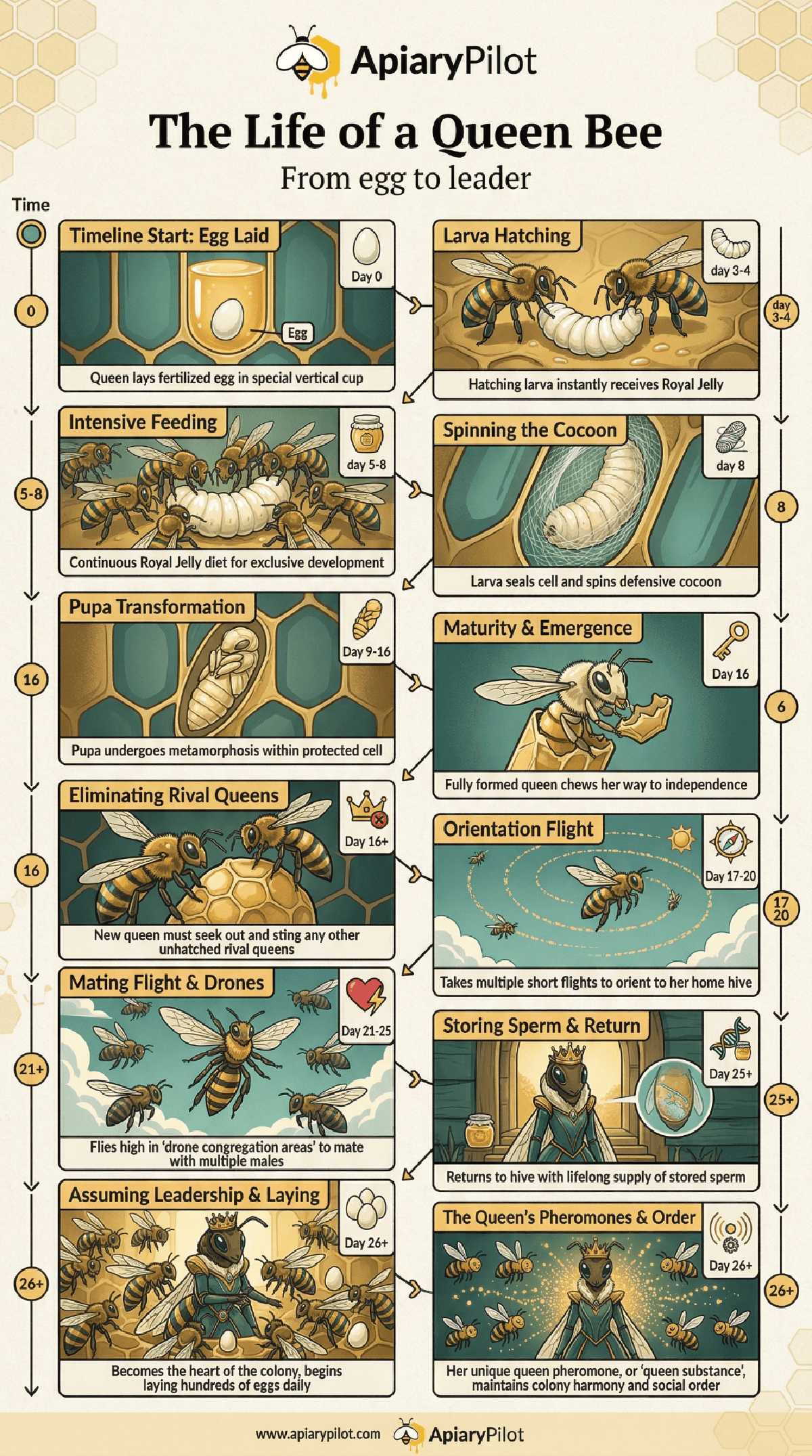
Day 0: The Egg is Laid
The process begins when a queen lays a fertilized egg inside a specially constructed vertical queen cup. This cell is larger than a standard worker cell, signaling the colony's intention to raise a new queen.
Days 3–4: Larva Hatching
The egg hatches into a tiny larva, which immediately begins receiving Royal Jelly — a protein-rich secretion produced by nurse bees. Unlike worker larvae, the future queen receives Royal Jelly exclusively throughout her entire larval development.
Days 5–8: Intensive Feeding
During this critical period, the larva is fed continuously with Royal Jelly. This exclusive diet triggers the developmental changes that differentiate a queen from a worker bee, including reproductive organ development and a larger body size.
Day 8: Spinning the Cocoon
The larva seals its cell and spins a protective cocoon around itself. Inside this silken enclosure, the dramatic metamorphosis from larva to adult bee begins — one of the most intensive transformations in the insect world.
Days 9–16: Pupa Transformation
Within the sealed cell, the pupa undergoes complete metamorphosis. Wings, legs, compound eyes, and reproductive organs all develop during this protected period. The queen cell becomes visibly elongated and textured.
Day 16: Maturity & Emergence
The fully formed queen chews her way through the wax cap of her cell. She emerges as an adult bee, larger and more elongated than workers, ready to claim her position in the colony hierarchy.
Day 16+: Eliminating Rival Queens
One of her first acts is to seek out and destroy any other queen cells or newly emerged rival queens. She uses her stinger — which unlike a worker's, can be used repeatedly — to eliminate competition.
Days 17–20: Orientation Flights
Before her mating flights, the young queen takes several short orientation flights around the hive. These help her memorize the location and landmarks so she can reliably return after her longer mating journeys.
Days 21–25: Mating Flight & Drones
The queen flies high into drone congregation areas where she mates with 10–20 drones from other colonies. This aerial mating ensures genetic diversity. The drones die after mating, while the queen stores enough sperm for her entire lifetime.
Day 25+: Storing Sperm & Return
After her mating flights, the queen returns to the hive with a lifelong supply of stored sperm in her spermatheca. She will never need to mate again, using this reserve to fertilize eggs for potentially 3–5 years.
Day 26+: Assuming Leadership & Laying
The queen settles into her primary role: laying eggs. A healthy, well-mated queen can lay up to 2,000 eggs per day during peak season. She becomes the heart of the colony, with all activity revolving around her presence.
The Queen's Pheromones & Order
Beyond egg-laying, the queen maintains colony harmony through her unique pheromone blend — the "queen substance." These chemical signals suppress worker reproduction, guide colony behavior, and signal the queen's health and vitality to every bee in the hive.

Why Understanding the Queen Matters
For beekeepers, knowing the queen's lifecycle is essential for timing inspections, managing requeening, and understanding colony dynamics. A healthy queen means a thriving hive — making her truly the most important bee in your apiary.
Ready to elevate your beekeeping?
Start tracking your hives, inspections, and harvests with ApiaryPilot — the modern hive management platform built for beekeepers like you.
Get started free