Roles Inside the Hive: Who Does What
Discover the fascinating division of labour inside a honey bee colony — from nurse bees and comb builders to guard bees and winter cluster specialists. A visual guide to every role across all four seasons.
About this roles inside the hive: who does what infographic
This beekeeping infographic turns the key decisions behind roles inside the hive: who does what into a visual reference that can be used during inspections, planning sessions, or training conversations. It is designed for practical apiary management, so each section highlights the observations, timing, and records that matter most in the field.
Use it as a quick reminder before opening colonies, preparing seasonal work, or reviewing hive notes with another beekeeper. For stronger records, keep the infographic beside your inspection journal and capture the matching hive data in ApiaryPilot, including dates, colony status, treatments, harvest actions, and follow-up tasks.
The download below is suitable for printing or sharing with a local beekeeping group. The embed code lets clubs, educators, and suppliers reference the infographic while linking back to the original ApiaryPilot guide page.
A honey bee colony is a superorganism where every individual has a specific job. Worker bees transition through different roles as they age, adapting to the colony's needs across the seasons. This infographic maps out the key roles and when they're most active throughout the year.
Spring Roles
Spring is all about rapid colony growth. As temperatures rise and flowers begin to bloom, the colony shifts into expansion mode.
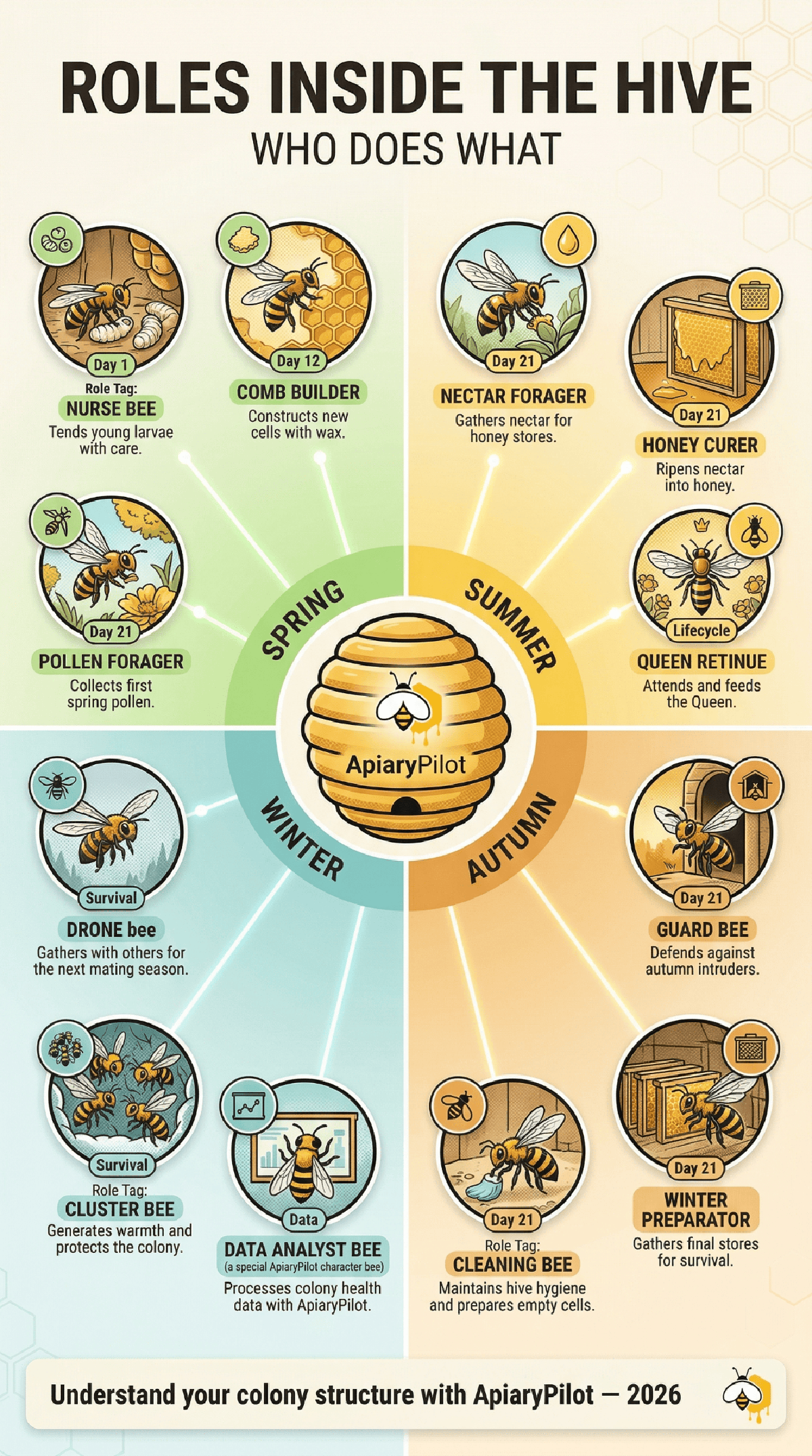
Nurse Bee (Day 1–12)
Newly emerged worker bees start their careers as nurse bees, tending to young larvae with care. They produce royal jelly from their hypopharyngeal glands and feed developing brood multiple times per day. A strong nursing workforce in spring is critical for building colony population ahead of the nectar flow.
Role tag: Day 1 Key task: Tends young larvae with care
Comb Builder (Day 12)
Around day 12, workers' wax glands become active. Comb builders construct new cells from beeswax, creating the hexagonal foundation the colony needs for brood rearing and food storage. In spring, comb building is at its peak as the colony expands into new frames.
Role tag: Day 12 Key task: Constructs new cells with wax
Pollen Forager (Day 21+)
Some of the first foragers in spring specialise in collecting pollen — the colony's protein source. Pollen is essential for feeding brood, and early spring pollen from willows, crocuses, and other early bloomers kickstarts colony growth.
Role tag: Day 21 Key task: Collects first spring pollen
Summer Roles
Summer brings peak activity. The colony is at full strength, and every role operates at maximum capacity.
Nectar Forager (Day 21+)
The most visible role — nectar foragers venture out up to 5 km from the hive, visiting hundreds of flowers per trip. They communicate the location of rich nectar sources through the waggle dance, coordinating the colony's foraging effort with remarkable precision.
Role tag: Day 21 Key task: Gathers nectar for honey stores
Honey Curer (Day 21+)
When nectar arrives at the hive, house bees process it into honey. They add enzymes, reduce moisture content through fanning and repeated regurgitation, and finally cap the cells with wax when the honey reaches the ideal moisture level of around 18%.
Role tag: Day 21 Key task: Ripens nectar into honey
Queen Retinue
A dedicated group of workers constantly attends to the queen — feeding her, grooming her, and distributing her pheromones throughout the colony. The retinue is essential for colony cohesion and signals to all workers that the queen is healthy and present.
Role tag: Lifecycle Key task: Attends and feeds the Queen
Autumn Roles
Autumn is about preparation and defence. The colony transitions from growth mode to survival mode.
Guard Bee (Day 21+)
As resources become scarce in autumn, robbing pressure from other colonies increases. Guard bees stationed at the entrance inspect every arriving bee, checking for the colony's unique pheromone signature. Intruders are challenged and driven away.
Role tag: Day 21 Key task: Defends against autumn intruders
Cleaning Bee
Hygiene becomes especially important as the colony prepares for winter. Cleaning bees remove dead brood, debris, and waste from cells, preparing them for the queen's final rounds of autumn egg-laying or for honey storage.
Role tag: Day 21 Key task: Maintains hive hygiene and prepares empty cells
Winter Preparator
These workers focus on gathering the final nectar and pollen stores the colony needs to survive winter. They also help seal cracks with propolis and ensure honey stores are properly capped and positioned for the winter cluster to access.
Role tag: Day 21 Key task: Gathers final stores for survival
Winter Roles
Winter is about survival. The colony contracts into a tight cluster and shifts to energy conservation.
Cluster Bee
The majority of winter bees form the cluster — a tight ball of bees that generates heat through muscle vibration. Outer bees insulate while inner bees generate warmth. Bees rotate positions, cycling between the cold outer shell and the warm interior.
Role tag: Survival Key task: Generates warmth and protects the colony
Drone Bee
While drones are typically expelled before winter, in milder climates some may persist into early winter. Their primary role remains preparation for the next mating season, gathering with drones from other colonies at drone congregation areas.
Role tag: Survival Key task: Gathers with others for the next mating season
Data Analyst Bee 🐝
A special ApiaryPilot character — the Data Analyst Bee represents the modern beekeeper's approach to colony management. Using apiary management software like ApiaryPilot, beekeepers process colony health data, track trends, and make informed decisions based on inspection records rather than guesswork.
Role tag: Data Key task: Processes colony health data with ApiaryPilot

Why Understanding Roles Matters
Knowing which roles are active helps you interpret what you see during inspections:
- Lots of nurse bees on brood frames — the colony is in growth mode
- Heavy comb building — the colony needs more space (time to add a super)
- Aggressive guard bees — robbing pressure may be high, consider reducing the entrance
- Tight winter cluster — the colony is healthy and conserving energy properly
Track Colony Behaviour with ApiaryPilot
ApiaryPilot's apiary management software lets you log detailed inspection observations about bee behaviour, brood patterns, and colony temperament. Over time, this data reveals patterns that help you predict colony needs and time your management interventions perfectly.
Ready to elevate your beekeeping?
Start tracking your hives, inspections, and harvests with ApiaryPilot — the modern hive management platform built for beekeepers like you.
Get started free